


Food for thought
Posted on 21 December 2015

Eating disorders are abnormal eating habits that negatively affect a person’s physical or mental health. According to Britain’s NHS, anorexia nervosa, bulimia nervosa and binge eating are the most common. Here are some other types you may not be aware of.
Compulsive overeating
If you feel uncomfortable after you’ve eaten, it’s an indication that you’ve eaten too much. A compulsive overeater does this regularly and usually becomes overweight. Such a person may also develop feelings of guilt. Compulsive overeating is sometimes referred to as food addiction and is a component of binge eating disorder.
Ilsabé Spoelstra, a dietician at Mediclinic Bloemfontein, explains: ‘The person has no control over certain things in their life and uses food as an escape. They get so conditioned to eating instead of resolving the problem in another way that it eventually gets established as an eating disorder. Some people simply cannot stop eating once they’re full. There are many physiological and psychological reasons for this.’
So how is compulsive overeating diagnosed and treated? Ilsabé says she has a passion for helping people as a dietician, but this eating disorder may also require seeing a psychologist or a life coach. ‘I use Maslow’s hierarchy of needs to illustrate and help the person understand that one should only eat to satisfy hunger; eating does not take away the underlying problem. You can eat as much as you can and just end up feeling uncomfortable, but the actual problem still remains. The person needs to acquire the skills of problem solving, and the psychologist’s role is applicable here. To eventually help the person to achieve a healthy body and mind will take a long time and lots of patience.’
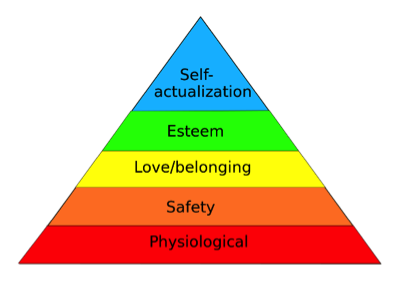
Psychologist Abraham Maslow’s hierarchy of needs is represented as a pyramid with the most basic human needs at the bottom.
Orthorexia
This is an obsession with eating foods you consider ‘pure’ or healthy. So why is it an eating disorder? Ilsabé explains: ‘When one has an obsession with healthy food to the point where your body or psyche suffers as a result, then it becomes unhealthy. Such a person will only eat organic food, for example, and will even resort to taking his or her own food wherever they go. Or they may become asocial because they don’t want to eat other people’s food.’
Ilsabé is currently treating such a patient. ‘The person is scared of any animal products and only eats vegetarian food. Although this isn’t a problem in itself, she had so little knowledge of her nutritional requirements that she ate no protein, and her skin deteriorated badly. After five months in therapy she has healed to the point where her skin is healthy and glowing, and she realises that she had caused herself great harm. There are, however, people who refuse to eat certain foods but are informed and eat a well-balanced diet – this is not orthorexia.’
Other less common eating disorders
Drunkorexia: This is when extreme weight control methods such as starvation or purging are used to compensate for planned binge drinking.
Gourmand syndrome: Gourmand syndrome is a rare condition that sometimes occurs in people who sustain injuries to the right frontal lobe. These people develop a new, post-injury passion for gourmet food.
Other: Ilsabé recently helped a person who would binge and then go for a 15km run.
Four out of 10 individuals have either personally experienced an eating disorder or know someone who has. If you’re one of them, contact your GP.


The information provided in this article was correct at the time of publishing. At Mediclinic we endeavour to provide our patients and readers with accurate and reliable information, which is why we continually review and update our content. However, due to the dynamic nature of clinical information and medicine, some information may from time to time become outdated prior to revision.
Share
Related articles

Healthy Life
Chemical dependency: how to treat it
Chemical dependency is a complex disease that changes lives forever – but help is possible. At Mediclinic Crescent Mental Health Services, a dedicated team helps patients find answers. Mediclinic Crescent


